Overview
Finish: Black finish, anti-corrosion treated
Material: High performance alloy steel, PVC coated handles
Application: Crimping die behind hinge for superior leverage when crimping
The edges designed to cut medium to hard wire
Gripping surfaces particularly suited to flat material
Specifications
Length: 250mm
Weight: 480g
Overview
Resettable pliers that complete the range of existing conventional circlip pliers
Patented pliers are equipped with interchangeable tips (straight, 15 ° and 90 °) which can easily be adapted for use with internal or external circlips as required
5 pairs of tips are supplied
Specifications
Overall Length: 160mm
Diameter Internal: 8-25mm
Diameter External: 3-25mm
Weight: 120g
Overview
Resettable pliers that complete the range of existing conventional circlip pliers
Patented pliers are equipped with interchangeable tips (straight, 15 ° and 90 °) which can easily be adapted for use with internal or external circlips as required
5 pairs of tips are supplied
Specifications
Overall Length: 200mm
Diameter Internal: 10-51mm
Diameter External: 7-51mm
Weight: 230g
Overview
Resettable pliers that complete the range of existing conventional circlip pliers
Patented pliers are equipped with interchangeable tips (straight, 15 ° and 90 °) which can easily be adapted for use with internal or external circlips as required
6 pairs of tips are supplied
Specifications
Overall Length: 250mm
Diameter Internal: 46-102mm
Diameter External: 32-102mm
Weight: 505g
Features
Set of three circlip pliers with interchangeable tips for both internal and external circlips in a plastic box
Patented pliers, equipped with interchangeable tips (straight, 15 ° and 90 °) which can easily be adapted for use with internal or external circlips
5 Pairs of tips are supplied with the -160 and -200 and 6 pairs with the -250
Valid for internal circlips from 8 to 100 mm diameter and for external circlips from 3 to 100 mm
Regulation stop mechanism for easier use and prevention of damage to circlips due to excessive force
The 2928-160 pliers, which thus covers a range of applications previously embraced by as many as 10 conventional pliers
Contents
2928-160
2928-200
2928-250
Overview
Paint scraper developed according to the scientific ERGO™ process
Specially designed for precision work such as scraping windows, moulding and narrow corners
Two-component handle provides ample space to scrape with both hands, better grip and excellent working comfort
Narrow front for a precision thumbgrip
Carbide blades
Supplied with 449, 25mm triangular blade
Delivered with a holster with integrated clip
Bakelite Ball End Tapered Handle with Brass Female Thread — engineered for seamless, tool-free installation and removal. This durable replacement accessory restores operational efficiency to milling machines, lathes, grinding machines, and comparable industrial equipment. Built from resilient bakelite that resists deformation and maintains reliable performance over extended use.
Bakelite Tapered Handle (Brass Female Thread) featuring threaded design for quick, tool-free installation and removal. Boost operational efficiency with this reliable replacement accessory for worn or damaged handles. Ideal for milling machines, lathes, grinding machines, and similar equipment. Constructed from durable bakelite material that resists deformation and delivers long-lasting performance.
Bakelite Tapered Handle (Male Thread) featuring threaded design for quick, tool-free installation and removal. Boost operational efficiency with this reliable replacement accessory for worn or damaged handles. Ideal for milling machines, lathes, grinding machines, and similar equipment. Constructed from durable bakelite material that resists deformation and delivers long-lasting performance.
AUSTRALIAN MADE
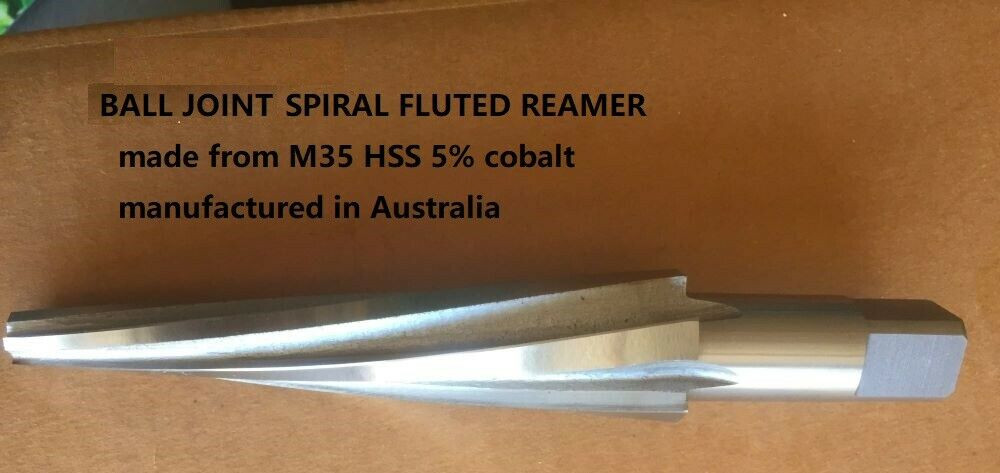
Tapered Spiral Fluted Ball Joint Hand Reamers
SUPER HIGH QUALITY PRODUCT
These Reamers are Australian made with Cobalt
added to the HSS
Ball Joint Calipers from used coupling will surface harden, which makes them very hard to re-ream, Cobalt will normally allow you to get under that skin into new material.
2 Size variations - choose up top.
A reamer is a type of rotary cutting Tools used in Metalwork. Precision reamers are designed to enlarge the size of a previously formed hole by a small amount but with a high degree of accuracy to leave smooth sides. There are also non-precision reamers which are used for more basic enlargement of holes or for removing burr’s. The process of enlarging the hole is called reaming.
Number:
Size
Taper
Small End
Large End
Flute Length
Overall Length
2
2" /FT
9.56 Degrees
3/8”
1-1/8”
4-1/2”
6-1/2”
2.5
1 - 1/2" /FT
7.15 Degrees
7/16”
1”
4-1/2”
6-1/2”
Product Description
Product Name
HSS Spiral Flute Ball Joint Taper Reamer
Material
5% Cobalt High Speed Steel
Shank
Straight Shank
Flute
Spiral Flute
Surface Finish
Bright
Package
Plastic Tube.
Features
Tapered reamers will help align holes,
remove burrs from cut pipe, tubing, and Conduit,
and enlarge and Countersink holes in sheet metal, plastic, and other materials
2.T-handle design for easy turning and sure handling.
Here's a guide on determining which ball joint reamer you need for tie rods:
Understand the purpose of the reamer: A ball joint reamer is a cutting tool used to enlarge the hole in a ball joint to allow for a larger diameter stud to be inserted. In the case of tie rods, a ball joint reamer is used to create a smooth and accurate hole for the ball joint stud to fit into.
Measure the ball joint stud: The first step in determining which ball joint reamer you need is to measure the ball joint stud. The diameter of the stud should be measured with a micrometer to determine the size of the hole that needs to be reamed.
Determine the required tolerance: Once you know the size of the stud, you need to determine the required tolerance. This is the amount of deviation from the exact size of the hole that is acceptable. The tolerance can vary depending on the specific application and the manufacturer's specifications.
Choose the appropriate reamer: Based on the size of the stud and the required tolerance, you can choose the appropriate ball joint reamer. Ball joint reamers come in various sizes and tolerances, so it's important to select the correct one for your needs. It's also important to choose a high-quality reamer made from durable materials like high-speed steel or carbide to ensure accuracy and longevity.
Ream the hole: Once you have the appropriate ball joint reamer, you can begin the reaming process. It's important to use proper technique and apply consistent pressure to achieve the desired results. The reaming process should be performed slowly and carefully to avoid damaging the tie rod or the reamer.
Check the fit: Once the hole has been reamed, it's important to check the fit of the ball joint stud. The stud should fit snugly into the hole without any excess play or tightness. If the fit is not correct, additional reaming or other adjustments may be necessary.
In summary, determining the appropriate ball joint reamer for tie rods involves measuring the size of the stud, determining the required tolerance, selecting the appropriate reamer, performing the reaming process with care and precision, and checking the fit of the ball joint stud. With proper technique and the right tools, you can achieve accurate and precise results.
Reaming tie rods is a common process that is performed to ensure that the ball joint studs fit securely into the tie rod ends. Here's a guide on how to use a reamer on tie rods:
Determine the required size: Before using a reamer on tie rods, it's important to determine the required size. This can be done by measuring the size of the ball joint stud using a micrometer. The reamer should be slightly larger than the size of the stud to ensure a proper fit.
Choose the appropriate reamer: Based on the size of the ball joint stud and the required tolerance, choose the appropriate reamer. Ball joint reamers are available in various sizes and tolerances, so it's important to select the correct one …
The Ball Nosed Cone Carbide Burr (Double Cut) is suitable for general purpose use on steel, cast iron and weld preparation. Designed for precise contour machining and edge rounding the small cutting teeth ensures a smooth finishing action.
A Double cut carbide burr is best to use with ferrous and non-ferrous metals, aluminum, soft steel, and all non-metal materials like plastics and wood. Double-cut burr has enough cutting edges to remove excess material quickly. They are also easier to control than single-cut burrs as they "jump" less due to better chip extraction.
Double-cut burrs are also known as diamond-cut burrs or cross-cut burrs (2 flutes cut across each other). They provide a highly smooth finish surface than a single-cut carbide burr.
The Ball Nosed Cone Carbide Burr (Single Cut) is suitable for general purpose use on steel, cast iron and weld preparation. Designed for precise contour machining and edge rounding the small cutting teeth ensures a smooth finishing action.
Single-cut burr is ideal for cutting hard metals such as chrome steel, hard steel, copper, cast iron, and ferrous metals. By cutting the material rapidly, a single-cut carbide burr can provide a smooth finish surface.
The Ball Nosed Cylindrical Carbide Burr (Double Cut) is suitable for general purpose use on steel, cast iron and weld preparation. Designed for precise contour machining and edge rounding the small cutting teeth ensures a smooth finishing action.
A Double cut carbide burr is best to use with ferrous and non-ferrous metals, aluminum, soft steel, and all non-metal materials like plastics and wood. Double-cut burr has enough cutting edges to remove excess material quickly. They are also easier to control than single-cut burrs as they "jump" less due to better chip extraction.
Double-cut burrs are also known as diamond-cut burrs or cross-cut burrs (2 flutes cut across each other). They provide a highly smooth finish surface than a single-cut carbide burr.
The Ball Nosed Cylindrical Carbide Burr (Single Cut) is suitable for general purpose use on steel, cast iron and weld preparation. Designed for precise contour machining and edge rounding the small cutting teeth ensures a smooth finishing action.
Single-cut burr is ideal for cutting hard metals such as chrome steel, hard steel, copper, cast iron, and ferrous metals. By cutting the material rapidly, a single-cut carbide burr can provide a smooth finish surface.
The Ball Nosed Cylindrical Carbide Burr (Single Cut) is suitable for general purpose use on steel, cast iron and weld preparation. Coarse cut is excellent for aluminium and non ferrous metals as it allows aggressive stock removal.
By cutting the material rapidly, a single-cut carbide burr can provide a smooth finish surface.
The Ball Nosed Tree Carbide Burr (Double Cut) is suitable for general purpose use on steel, cast iron and weld preparation. Designed for precise contour machining and edge rounding the small cutting teeth ensures a smooth finishing action.
A Double cut carbide burr is best to use with ferrous and non-ferrous metals, aluminum, soft steel, and all non-metal materials like plastics and wood. Double-cut burr has enough cutting edges to remove excess material quickly. They are also easier to control than single-cut burrs as they "jump" less due to better chip extraction.
Double-cut burrs are also known as diamond-cut burrs or cross-cut burrs (2 flutes cut across each other). They provide a highly smooth finish surface than a single-cut carbide burr.
The Ball Nosed Tree Carbide Burr (Single Cut) is suitable for general purpose use on steel, cast iron and weld preparation. Designed for precise contour machining and edge rounding the small cutting teeth ensures a smooth finishing action.
Single-cut burr is ideal for cutting hard metals such as chrome steel, hard steel, copper, cast iron, and ferrous metals. By cutting the material rapidly, a single-cut carbide burr can provide a smooth finish surface.
The Ball Shape Carbide Burr (Double Cut) is suitable for general purpose use on steel, cast iron and weld preparation. Designed for precise contour machining and edge rounding the small cutting teeth ensures a smooth finishing action.
A Double cut carbide burr is best to use with ferrous and non-ferrous metals, aluminum, soft steel, and all non-metal materials like plastics and wood. Double-cut burr has enough cutting edges to remove excess material quickly. They are also easier to control than single-cut burrs as they "jump" less due to better chip extraction.
Double-cut burrs are also known as diamond-cut burrs or cross-cut burrs (2 flutes cut across each other). They provide a highly smooth finish surface than a single-cut carbide burr.
The Ball Shape Carbide Burr (Single Cut) is suitable for general purpose use on steel, cast iron and weld preparation. Designed for precise contour machining and edge rounding the small cutting teeth ensures a smooth finishing action.
Single-cut burr is ideal for cutting hard metals such as chrome steel, hard steel, copper, cast iron, and ferrous metals. By cutting the material rapidly, a single-cut carbide burr can provide a smooth finish surface.
The Ball Shape Carbide Burr (Single Cut) is suitable for general purpose use on steel, cast iron and weld preparation. Coarse cut is excellent for aluminium and non ferrous metals as it allows aggressive stock removal.
By cutting the material rapidly, a single-cut carbide burr can provide a smooth finish surface.
Early collection: selected tool ranges from a small number of Australian suppliers. Prices and stock are observations from the linked page and may apply to a selected option. Confirm the exact size, condition and delivery with the seller.